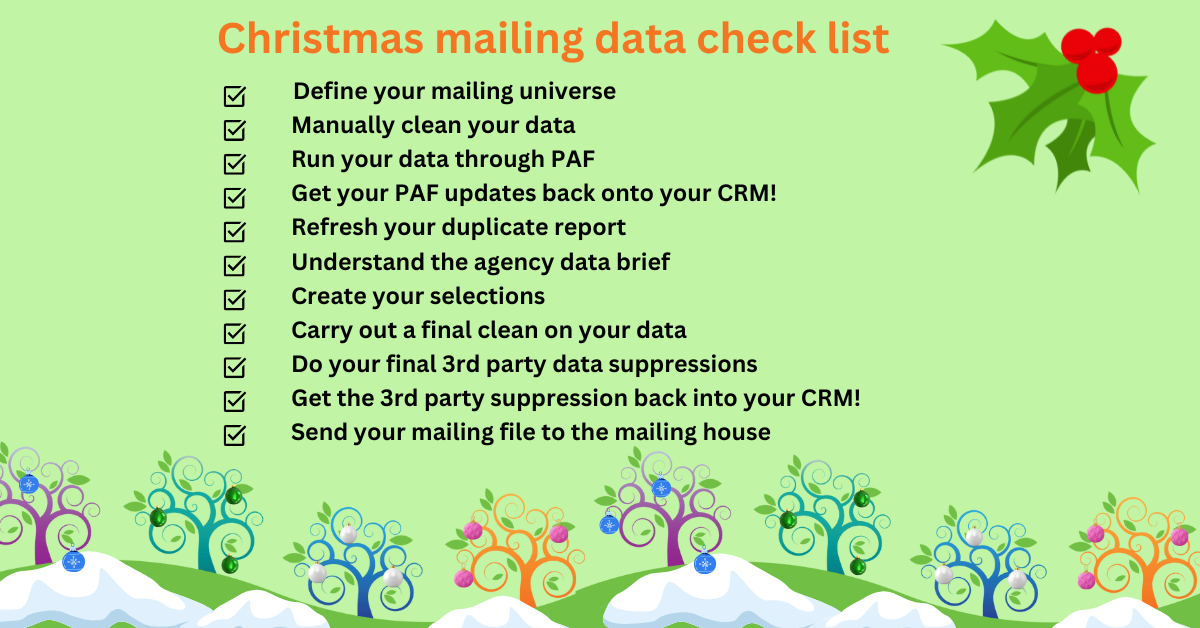
It is never too early to think about your Christmas checklist
Is it too early to mention the C word?
I was sitting in a cottage near the coast in the Norfolk Broads, looking out at a grey and miserable afternoon in July.
Whilst my brain was telling me it’s July in England my heart is shouting, where’s the lovely weather gone we had a couple of weeks back?
This weather doesn’t inspire anything, let alone talking about the warmth and jolliness of the December festive season.
But that’s ok, because this isn’t going to be a blog about theology, false timing, pagan sources or other contentious areas of Christmas, the festive season, Wintertime Solstice or whatever you would like to call it.
I’m also not prepared to delve into the complex social issues that crop up and are exacerbated during December and January.
Nope, none of those things. What I’m here to talk about is when you should start planning your seasonal campaigns that involve… drum roll please… DATA!
After too many years working with fundraising data, I’ve come to know a few ‘certainties’.
- People will tell me, for certain, that Raiser’s Edge cannot do things that it absolutely can.
- No one ever learns how to use pivot tables when they are the single most powerful (and free) tool that Fundraisers have available to them.
- Organisations will opt to do nothing with their data because – and I quote – “…we’re far too small…”
- Everyone thinks that doing that data clean three years ago means they probably aren’t due another clean for, like, ever!
- No one will bother looking at sorting their data out and planning data actions more than a week or two before they send out their most profitable appeal of the year.
It’s so hard to imagine that you’d go to all that effort to plan out a multi-channel campaign, track down engaging stories, invest in top-notch creative, have 37 pre-campaign meetings with the Agency and then, after all that, go “…uh, should we do some kind of data brief?”
At some stage someone might think to ask the Agency when they need data for only to be told it was due last week.
So, in the New World that we find ourselves living in, can we make a pact. Please?
Let’s have a think about what would give this year’s appeal the best chance of success.
Here’s my Christmas checklist, which you could start now:
1. Create a base query/list/filter/report – which is a list that contains everyone you could possibly include in a mailing. Don’t worry about segments at this stage, you just want a decent universe of data to select from. Exclude your deads and those with no addresses, those you definitely can’t contact. Now is a good time to challenge stuff that has routinely been excluded. That random list of tags or constituent codes; what are they? Why are you excluding records that have a specific date added?
2. Take the records in this base query and do some manual cleaning. Get the address elements in the right place, sort out the names so the addressee and salutations display properly. You can set up some queries/lists/filters/reports to find things like ‘no space in the postcode’, ‘first line of the address is blank but the second isn’t’, ‘spaces in the first name’ (this one wheedles out where first and middle names are in one field). If you see a recurring issue in the data, try and find all records with the same issue. Where possible find the source of the issue and stop it happening again (nothing to do with Christmas, but a nice Brucie Bonus).
3. Now you can run your data through PAF (Postal Address Finder). I use Data 8, but there are plenty of other providers that can do this. Stick to PAF at the moment – we’re going to do this in stages.
4. Get your PAF updates back onto your CRM.
5. Now, refresh your duplicate report. The better the quality of data the more chance your CRM has of finding and matching duplicates. The more duplicates you deal with, the more records will have a full giving history attached to them, rather than it being split across different records. A full giving history means people go into the right segment. The right segment means they get the most appropriate ask wrapped up in the best tone of message.
6. If you’re using an external Agency, get them to send you a brief. Read through it several times (essential if you’re not familiar with data processing briefs) and ask questions for clarification now.
7. Create the selection query/list/filter/report and do a dry run. Get a colleague to do some spot checking across every segment and get them to feed back a bulleted list of issues with record ID and what they feel the issue is. Go through each one and dig into the data and see if your selection needs refining. Use this time to familiarise yourself with how your CRM can help you do your selection. In Raiser’s Edge you can use Quick Letters, in Donorfy you can use Campaign Members. Other CRM’s will have their own similar tools to help you.
8. A week or two ahead of the data supply date, do a final data clean. This time run the selection and only refine the data that will be included. Be careful to check on records that might be excluded because of something simple like a missing postcode, which can be easily fixed. You’re aiming for the greatest amount of good quality data, so double check those addressees and salutations.
9. Now is the time to do the final third-party data suppression: deads, goneaways and movers. I stick to using three dead lists, three goneaway lists and NCOA Update for movers (if you have the budget). Avoid using GAS if possible as it oversuppresses and don’t be tempted to use every list available – if a record has passed through 8 lists which have said the person isn’t dead and the 9th says they are, do you believe it? Probably not. More is not better.
10. Get the suppressions back onto your CRM so they can be used for other activities – it’s more cost effective to buy the suppression flags than to suppress only. Ensure everything that should be removed from your selection is taken out and that addresses are updated if you have purchased the forwarding addresses.
11. Now you can send the file to the Agency or to the Mailing House.
Once you’ve got to this stage you can’t do anything else, but you can be confident you’ve done as much as you can reasonably do to ensure the success of your appeal.
You can also see that the above list doesn’t need you to have a supporter base of millions; you can do this even if all you have is a couple of hundred names.
The principles are still the same.
Your segments will be fewer in number – maybe only two, one segment of people who have donated recently and one for everyone else – but you can still ensure you are sending an appropriate message and ask to your lovely, generous supporters.
And if you still need more help on segments, well… that’s for another time.